2002. Dog needs owner. Girl needs dog. An adoption from the Washington Animal Rescue League in Washington, DC is the beginning of a beautiful relationship! Follow Pongo's adventures today as he hikes, learns the new sport of nose work, and spends his days playing with the family's four cats in Western Washington. Stay tuned as his amazing life story unfolds.


Showing posts with label nosework competition. Show all posts

Sunday, February 22, 2015

The 3 Out Of 4 Club

After yesterday's Nose Work 1 Trial in Oakville, WA, we are now solidly entrenched in the 3 out of 4 club. It's hard not to feel disappointed, but what I have to remind myself is that Pongo loved the excitement of the trial site, seeing all the other dogs, and playing the game he loves: find the odor.  He doesn't know that he didn't earn a ribbon or a title on a piece of paper.  Those are human constructs.

Pongo gets a drink of water in the truck.
 Oakville is not far from Olympia, just eleven miles off of I-5 on Highway 12.  Mapquest estimated it would take us an hour and seventeen minutes from our house.  We left at 7 am, stopped for coffee on the way, and jetted into our day long journey. Because Pongo has been slow to start in the last two trials, failing to pass the first element of the day, we pulled over at a rest stop on the way to practice.  I did two hides with him outside, practicing an exterior hide.  Pongo was understandably distracted on the first one, not sure whether he was there to pee. The second one was better, but he was still very distracted.  I hoped it was enough of a practice to help him get right into the game at the trial site.

Each trial we have been to has done things a little different.  Sometimes elements are run simultaneously, sometimes back-to-back.  There are always 40 dogs divided into two groups of 20.  Yesterday we were in Group B, Team No. 6.  I liked being at the front of our group, but the Oakville trial ran the containers and exterior elements back-to-back so that teams went directly to the exterior hide after finishing with containers. That meant that we had a long wait time before we even started, as Group A ran through two elements first.
Our number did not come up until almost 11:30 am.

Pongo rocked through containers.  Next we went out a side door of the high school to a flagged-off area that included grass and the side of the building. Pongo got to work after looking out at all the people standing around watching. I felt cautious, noting that he took interest in a couple different spots, but not wanting to make a mistake, let him keep going, then directing him back to the areas he'd shown interest before.  I called alert when he stopped again and stuck to a utility cylinder next to the wall. YES!  Relief and excitement washed over me.  We'd made it through the first half of the day!
At the truck, playing the waiting game.

We went back to the truck to wait.  Thankfully, they reversed the order in the afternoon and Group B would go first after lunch.  We purchased delicious baked potatoes from a concession stand inside the school which was being run to raise money for a senior class trip. We felt good about supporting such a small town school and were delighted to not have to leave to find something to eat.

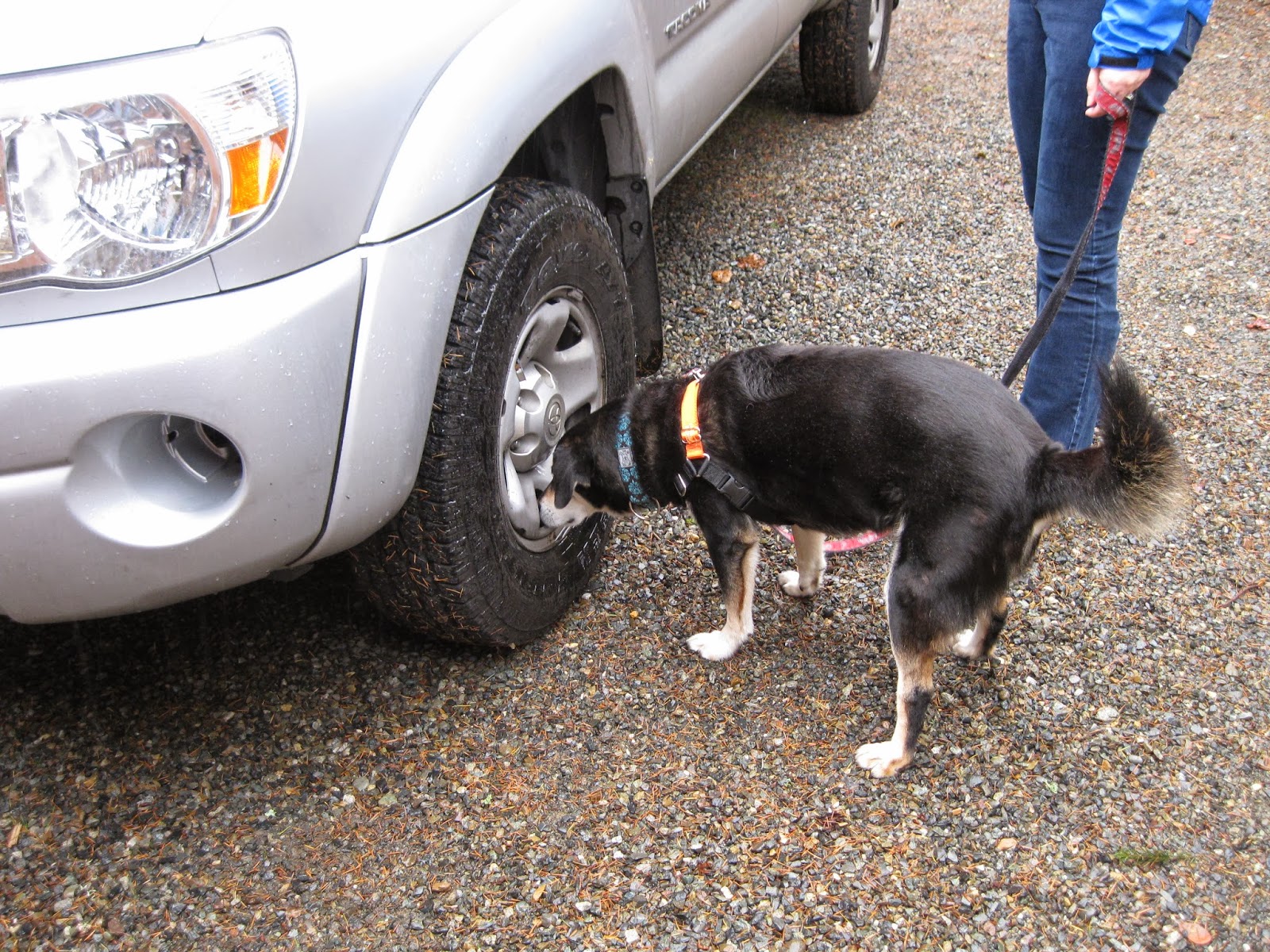
The afternoon elements started with vehicles and then the interior search.  Pongo seemed perky and ready to go.  But when we came through the door to the vehicle search which was in a covered area open at both ends between school buildings, Pongo froze.  He looked at all the people standing in a line with timers or clipboards in their hands.  He sniffed the air.  The wind was blowing as if through a tunnel.  I took Pongo to the first vehicle and he started sniffing.  But at the end of each vehicle, he seemed to pause, distracted, and I had to turn him around and get him to go down the other side.  I started feeling nervous.  It felt as if I were in a vacuum, time getting sucked away.  I remembered the advice of the judge at our last trial. "You have to get your dog around all three vehicles."

The vehicles were parked side by side, parallel to each other with ample walking distance in between.  We ended up back at the first vehicle and Pongo showed a lot of interest at the back left wheel.  I wasn't sure if that was it, so I let him work it around to the other side.  At this point, I thought the odor was blowing under the vehicle, but Pongo was not giving me any strong signals.  We ran out of time.  The judge verified that Pongo had been in odor at the rear left wheel, but that the hide was in the hitch on the tailgate.  Pongo had walked right past it.

I buyoed my spirits as we went indoors to the interior and the last hide.  Dogs are allowed to be worked on or off leash, and Pongo has typically done well being off, so I started that way.  But as time passed, I felt he was not working the whole room and I put him back on the leash. I called alert just in the nick of time.  The entire room let out a big sigh as if they had been holding their breath.

"I'll call that 2:59." the judge said. There was nervous laughter.

"What a good boy, Po!"  We hurried out of the room and back to the truck.

Rather than stay for the award ceremony which was still hours away, we decided to leave.  We were tired and feeling defeated.  On the way home, we stopped in Olympia to look around.  As close as it is to us, I've never spent any time exploring there.  We took a downtown exit and left the truck at Heritage Park.  Pongo and I walked in the beautiful sunshine on the edge of Capitol Lake.

Next Del and I looked for a place to eat an early dinner.  We wandered into the 5th Avenue Sandwich shop.  I loved the old jazz music and pictures on the wall. Service was reasonably quick but the sandwiches were to die for.  Made from homemade bread daily, they were just running out of bread and closed after serving us.  I had a melted four cheese sandwich with an avocado spread and spinach.  It hit the spot!  Perfect on a crisp February day.  Del ordered a club sandwich without the bacon, but the waiter brought the thick slices of bacon on the side, trying to convince Del that it would be worth eating.  My husband, being a very particular eater, especially when it comes to bacon, declined.  Instead, the bacon went in a TO GO box where Pongo, waiting dutifully in the truck, devoured it immediately without question.


Wednesday, February 18, 2015

A Mock Nose Work Trial

Yesterday was a beautiful day for nose work in the Pacific Northwest! It was an unseasonably warm day with a brilliant blue sky.  Pongo is getting ready for another nose work trial this Saturday.  He's hoping to earn his Nose Work 1 (NW1) Title from the National Association of Canine Scent Work (NACSW). They say the third time is a charm, right?

My friend Mary set up a mock trial at her house for us to practice.  If you've read other blogs, you'll remember that Mary and her dog Crosby are longstanding nose work friends who are part of a practice group we've established. Crosby earned his NW1 title in Sandy, Oregon in November.  See "Pongo's Second Nose Work 1 Trial" posted on November 9, 2014.  I noticed a pattern in Pongo's behavior at this trial. Pongo starts off highly distracted and seems to need more warm-up time than just the trial boxes that are set up outside in the parking lot at trials.  Both times Pongo has competed, he has failed the first element (different elements each time) and passed the final three.  There are always four elements in a NW1 Trial: boxes, interior search, exterior search and vehicle search.  Your dog must pass all four to earn a title.

Knowing Pongo's tendency to a slow start, Mary planned five blind searches for us.  Each one was timed according to NW1 element standards.  The first one was an indoor search to get him warmed up.  Pongo circled the room, and was clearly working intermittently, but gave up easily and began looking to me.  Mary gave us the 30 second warning, then Pongo found the hide just before the time ran out at three minutes.  It was hung in a bag underneath a corner table.  Pongo was showered with lots of praise and cut up pieces of chicken Dog Joy Treats made by Freshpet.  Positive reward is important in training dogs for nose work to maintain their motivation.
Interior search with distractions.
Next, we went outside for a 3-car vehicle search.  Pongo was focused and quickly found the hide.  Pongo and Crosby took turns searching.
Crosby alerts to a find hidden in the wheel.
After the vehicle hide, the boys did a box search in Mary's garage.  There were lots of distractors with filled garbage cans, a parked vehicle, and shelves of your run-of-the-mill items stored in garages.  Boxes is where Pongo typically excels.  He got his best time on this element, finishing in less than fifteen seconds.  Pongo gave me a clear alert by pawing the box with the odor.  I love it when he does this on boxes and wish he'd do it on all hides!  But Pongo's alert is different depending on the situation, putting more pressure on me to make sure I read him correctly.  This is a team sport after all! 

Next, the dogs did an interior search in the living room.  This search area was full of lots of distractors.  It had some of Crosby's toys, a dog bed, a throw blanket tossed on the couch, etc.  This one proved to be very difficult for Pongo and was the only one he didn't find.  Mary hid the odor between the cushions and Pongo walked past multiple times without showing any signs of alerting to the odor.  But this is why we practice!  
Our practice session ended with an exterior search. Pongo found the odor hidden on a metal cat statue with plenty of time to spare.  What a fun day!  Many thanks to Mary for putting together a great practice session.  I'm so grateful for good friends.

    
       Pongo alerts on a metal cat statue.
Wish us luck! 

Happy trialing, Pongo!

Stay tuned for results this weekend.

Sunday, November 9, 2014

Pongo's Second Nose Work 1 Trial

Pongo's second NACSW nose work trial was November 2nd in Sandy, Oregon located 25 miles from Portland. Friend Mary Ellrodt and her dog, Crosby, were also entered in the Sandy, Oregon trial. If you have read my other blogs, Mary and I sometimes get our dogs together for nosework practice on the weekends.  Mary picked me up on Saturday afternoon and we loaded Pongo in the back of her SUV next to Crosby.  We headed for I-5 South as our adventure began.

We arrived in Sandy around 5:30 and promptly checked into the local Best Western.  We had a room on the first floor, halfway down the hall.  I was starving and eager to go find dinner.  We decided on Thai food, one of my favorite cuisines.  Since my husband doesn't like Thai food, I take every opportunity I can to eat it when out with friends.  Mary found the address of a couple Thai restaurants on her phone and we headed out the door.  The amazing thing about the competition dog world, regardless of the sport, is that you begin to recognize people.  Many of the nose work competitors were staying at the Best Western and had been given rooms on the first floor. We saw many people going in and out with their dogs.   I recognized a few people from the Bellingham trial, from an ORT I volunteered for in Fife in September, and a trial I volunteered for at Emerald Downs in October. 
 
When we got to Thai Home on Pionner Boulevard it was full.  I recognized a woman we had just seen at the hotel and who had been at both the Bellingham and Emerald Downs trials. There was a twenty minute wait, so we decided to walk to the nearby Amarin Thai on Proctor.  After a quiet dinner of pad thai, vegetable rolls and a green curry eggplant dish, we returned to the hotel satiated and ready to settle down for the night.  I was excited about the next day, but thankfully was not as anxious as I had been for our first nose work trial.  I was tired from a long, busy work week and the fluffy hotel bed lulled me quickly into sleep.
 
The next morning, we walked the dogs before loading them in the car.  We ate breakfast at the hotel's breakfast bar and chatted with other nose work competitors that were there.  After checking out, we drove the short distance to the trial site.  It was located at the Oral Hull School for the Blind on the outskirts of town.  Surrounded by pastures, it was a picturesque site where the sound of cows and other rural animals (whose vocalizations were not so identifiable to a city girl) floated in the air.
 

We parked the car and went to register in time for the 8:45 check-in. It was a typical Pacific Northwest morning - drizzling and in the 50s. There were two groups of twenty competitors each.  We learned that Mary and Crosby were in Group A, while Pongo and I were in Group B.  That meant that we were not scheduled close together and in the morning's trials were competing in a different element order. During our 9 am walk-through, we learned that the vehicle and interior searches were scheduled for the morning.  The exterior and container searches were scheduled for the afternoon after a short lunch break.
Pongo checks out all the activity at the trial.


The trial started early right after the walk-through at 9:35.  Both groups ran simultaneously.  Group A started on the interior search and Group B started on the vehicle search and then would swap.   We watched the colored flip charts to indicate by number who was next. Pongo and I were number 14.  When we finally arrived for our turn at the vehicle search, I walked him to the starting line.  There were three vehicles parked in a cement lot with a vast green field to the right.  I gave Pongo his command to search and he started off toward the closest vehicle.  He began to work, sniffing at the fender then going to the right back wheel well.  But then he looked off into the field and kept walking.  I directed him back to the vehicle, continuing the search, but Pongo was distracted, looking around, his interest on the field.  NACSW rules alot three minutes for the vehicle search.  Pongo showed interest in the first vehicle, but didn't alert.  I actually thought the odor might be on that vehicle and took him around it more than once.  Time ticked away and I began to feel nervous.  He wasn't finding it!  This wasn't like Pongo, as he usually did so well with vehicle searches! I knew we had to search the other two vehicles.  I took him to the second vehicle, but had to keep giving Pongo hand cues to inspect it.  He wasn't interested and kept looking around. One of the timers called 30 seconds to indicate we were almost out of time.  I took him to the third vehicle, but did not circle the entire vehicle before taking Pongo back to the first one.  Before I knew it, we had run out of time!  My heart sank.  It didn't matter how Pongo did on the rest of his searches, he would not title today. 

The judge showed me where the odor was and I rewarded Pongo with treats next to it.  The judge pointed out that we had not made it all the way around the vehicle.  I should have known better!  I chastised myself.  You have to make sure you direct your dog around all of the vehicles -- that's your responsibility as the handler.  He told me it wasn't on the first vehicle and I didn't believe him because he was so distracted.  I had violated the nose work mantra: trust your dog! 

"We timed out," I told Mary when we got back to the car.  I tried not to sink into my disappointment.  Mary and Crosby had passed their interior search.  "Remind me later to tell you the funny thing that happened," she replied.  It was hard not to talk about the details of the search, but we weren't allowed to until it was over.  I lamented over the fact that now a pattern had emerged for us on trial day. Pongo failed the first element search both times.  It seemed I would need do something differently to help him understand that it was a nose work competition before going into the first element.  But just using the practice boxes at the trial site was not enough. 

As Group A and B swapped element order, Crosby went to do the vehicle search and Pongo went to do the interior search, which was located in the kitchen of an outlying office building.  We were alotted three minutes and were allowed to search on or off leash.  I took Pongo to the startline, gave him his search word and let him off leash.  There was a judge and a timer in the kitchen with us, but back-up timers and other volunteers were in the adjacent office watching.  The kitchen was full of stuff - boxes on the floor, an open garbage can, a large old-fashioned scale, among other things.  Pongo showed interest in the scale but then went to the garbage can.  After a prolonged sniff there, he circled to the left side of the kitchen where there were boxes of stryofoam cups.  Then, all of a sudden, he jetted out of the search area into the office.  He ignored my calls, and I had to retrieve him by the collar from where he was sniffing around an old fireplace. I took him back to the search area and gave him his command again.  Almost immediately, he went back to the scale and stayed with it. "Alert," I called.  "Yes," the judge confirmed.  Pongo's search time was one minute, twelve seconds. Not bad, I thought for leaving the search area!  Later, Mary told me that Crosby had also left the search area.  He ran into a dark closet and when she tried to retrieve him by the collar, she tripped over a fan.  Crosby has progressively lost his hearing in the past couple of years due to old age (Crosby is 12) and so she can no longer recall him by voice.  One can only love him for the comedy he brings to nose work!

We decided not to leave for lunch because of the short time constraints and snacked on cheese and fruit that we had brought in a cooler.  Organizers decided to run Group A through the exterior and container searches back-to-back and then run Group B, rather than running the two groups on opposite elements at the same time and switch.  Pongo and I waited in the car while Crosby searched. The second half of the trial was going fast.  Mary came back ecstatic that Crosby had passed all four elements, giving him his Nose Work 1 Title.  Yea for Crosby!  I had felt all along that they would pass in Sandy, as they have worked consistently week after week in nose work classes at Paw-abilities. 
 
Finally, it was Pongo's turn again.  Mary used my camera to take videos before we went into the search area. Now I focused on having fun with Pongo.  I wanted positivity to run down the leash so that he would enjoy himself.  After all, it WAS all about him.  The reason we started doing nose work in the first place was to keep his mind engaged now that he could no longer go jogging due to his arthritis.   The exterior search was held in an outdoor area of the school that had benches arranged in a circle around a large fire pit.  The fire pit was full of ash as if it had been frequently used.  Pongo spent a long time sniffing around the pit, but then made his way to a bench on the far side where he correctly alerted.  His time was one minute seven seconds.  Next we went to the container search, which was done on white boxes that were thankfully indoors this time.  He found the odor in 17 seconds.  
 
When the trial was over, we stayed for the ribbon ceremony and to hear the judges' feedback.   


Mary Accepts Trial Ribbon
Although it was a long day, it was worth staying to hear the judges' feedback.  Both trial judges that day were police officers (one retired and one active) who had years of experience with search dogs. They emphasized checking wind conditions when performing exterior searches and that you work into the wind.  Look at the trees or the flags that mark the search area to tell which direction the wind is blowing.  They suggested checking the wind at the level of the dog's nose. The judges also commented that if you let your dog start in a random search pattern but are not successful, then you should lead him into a pattern.  In addition, they noted that in practicing vehicle searches, you should use different vehicles, not just your own, and that it is helpful sometimes to use more than 3.  Mary and I both asked questions about our particular trial difficulties that day.  The judge told Mary that when working off leash on an interior search that it was okay to ask the judge for a volunteer to block the door since Crosby was deaf and did not have voice recall.  The judge told me that dogs are still dogs and that they will be tempted by specific breed distractors, i.e. an open field, birds, squirrels.  The key, he said, was to train amply in those situations so that your dog would learn to stay focused on the search.
 
After the ceremony, we retrieved our NACSW Trial Score Books and read through the judges' comments on the score sheets.
 
 The Judges' Comments for Pongo and Eva:

Vehicle Search: "Timed Out. Make sure to get your dog around all the vehicles." Hide Found: No. Time: Timed Out. Time Limit: 3 minutes

Interior Search: "Nice work by handler to keep dog focused and hunting.  Good alert on hide - nice job!" Hide Found: Yes.  1 minute 12 seconds. Time limit: 3 minutes.

Exterior Search: "Good search pattern and direction by handler. Nice alert on hide.  Nice work!" Hide Found: Yes. Time: 1 minute 7 seconds. Time Limit: 3 minutes.

Container Search: "Good job." Hide Found: Yes. Time: 17.66 seconds. Time Limit 2 minutes 30 seconds.
 
The day ended with two happy canines dozing and two happy humans beaming on the drive home.  I felt exhilarated, adrenaline running through me even though the day was over.  It had been a wonderful weekend.  Although Pongo had not earned his title, he had improved his search times dramatically, and I had learned a lot to help us in our training.  But above all else, we had fun! 


Tuesday, July 29, 2014

Preparing For Pongo's First Nosework Trial

When I recently entered Pongo in a nosework trial in Whatcom County over Labor Day weekend, we were wait-listed.  Nosework is becoming so popular and there are so few events in Washington state that trials fill up quickly.  We were number nine on the list even though I submitted my online entry on the opening day of entries.  Thankfully, last week I got an email confirming that we had made it off the waiting list and that we were entered! 

Although I had such good intentions at the beginning of the summer to practice nosework, in reality we have done very little.  We dropped in on a class at Paws-abilities once and practiced a couple times with friends.  Now it was time to up the ante!  Last night we did another drop in class where we practiced uneven surfaces.  Our instructor had created some very unique hides around the room.  There were a series of baby gates laying on the floor, folding tables upended, tarps covering boxes and more.  I was a little concerned that Pongo would not do well, as he doesn't like working on gravel.  Because we did lots of obedience in his younger years, Pongo has a strong sense of  what's right and wrong. He was taught to stay off furniture and he doesn't climb or put his paws up on things.  This has been challenging in training him to do nosework where I want him to get on his hind legs and put his paws up to find high hides.  When it was his turn, he initially skirted each obstacle, but once I showed him it was okay to walk on each one, he had no problem!  However, he needed all of the hides paired with food, a signal to me that we have not done enough work.

This morning we met for a nosework date at our friend Ellie's house near the lake.   We met early to try and avoid the heat, but at 9 a.m., the sky was clear blue and the sun reflected sharply off the water.  Ellie prepared outdoor hides in her yard, on her deck and on the neighbor's deck as well.  After initially pairing hides with food in Ellie's yard, Pongo alerted to odors that were not paired in the neighbor's yard.  Here he alerts to an odor that is hid behind a plastic container.  An unexpected distraction for him was the neighbor's sprinkler that moved in a circular pattern, raining on us from time to time.   He initially started but was able to keep working.  It is exciting to see Pongo making gains in his nosework skills.
 
Working with Lincoln, Ellie rewards him for finding a hide underneath a tomato planter on the deck. Daisy had an off day, failing to alert on odors she was standing right over.  We speculated about the angle of the wind and which direction the odor was wafting. But I wondered if her unusual performance was more due to residual odor from the baked liver I was using to reward Pongo.  It was a little crumbly and we kept accidentally dropping small bits. Although Pongo loves liver, I'm not sure that I will use it again for nosework.
 After working in the heat, Mary let Crosby swim in the lake - a wonderful reward for a hot dog! I loved watching him and his natural swimming abilities. He glided effortlessly through the water, seeming to barely move his hind legs. 

 Alas, Pongo eyed the water and refused to go out farther than the first step! My silly Po!  He's not a swimmer, and he decided it was too deep by the docks for him to wade. But he went home a happy boy and has been sleeping most of the day.   Maybe he was dreaming of more nosework training on a beautiful summer day with views of the lake and Mt. Rainier . . . ah, the life!

Tuesday, November 26, 2013

Sniff & Go

What is a Sniff & Go? You're probably wondering, just as I did. I had never heard of one! It's a fun sniffing practice session held by certified nose work instructors!  Now that Pongo passed the Odor Recognition Test (ORT) in September, and we were again taking a nose work class, I began to consider entering him in his first nose work trial.  I read a wonderful guest blog where Jason Heng, a Certified Nose Work Instructor, talked about how to know when your dog is ready for a K9 nose work trial.  http://k9noseworkblog.blogspot.com/2013/11/guest-blogger-jason-heng-cnwi-answers.html  I came away from reading the article feeling that Pongo and I need more practice.  Our own instructor, Diane Porter, at Paws-abilities then told me about a Sniff & Go in Gig Harbor that was being held on November 23rd.  I filled out the entry form and mailed in my $30. 

On Saturday, after much begging, my husband agreed to go with me and take pictures and video.  The event was being held on private property in Gig Harbor. When we drove up the driveway, I suddenly felt I was in heaven.  There was an empty horse pasture, an open field and grass that sloped down the hill.  The house and barn sat on 40 acres of land, much of which was wooded.

Everyone parked in the pasture, lined up on the grass in a neat row. 


The Sniff & Go was for Level 1, 2 and 3 hides consisting of both vehicle and exterior searches.  We arrived at 10 am for Level 1.  Level 1 hides are done only with birch.


The organizers offered coffee and a warm place to rest inside the barn.  The temperature was in the 30s when we left home in the morning. I had dressed in several layers, including thermal underwear and tights as I knew we would be outside for a long time.  The warm barn was a wonderful surprise!

The instructors explained how the Sniff & Go would run and then we did a walk-through of each of the search areas, the boundaries marked by orange flags.  What I liked was that they emphasized the atmosphere was intended to be relaxed and encouraged us to ask questions if we had them.  We would be timed, but there would be no placements and we were free to go when we were finished with our searches.  We were divided into two groups so that each group could be running simultaneously.  The lower set of searches consisted of two exterior searches and one vehicle hide.  Then the higher set of searches consisted of one exterior search and one vehicle hide. 

Pongo and I were the second dog-handler team in the first group.  When it was our turn, we queued up by the orange cones to the first exterior search.  You will notice in the video below that Pongo alerts to the odor within seconds, but I don't recognize it and we continue searching.  I ask the judges a question about search boundaries, and then Pongo brings me right back to where he pointed it out before.

Pongo had found the odor so quickly that I didn't trust him. No, similar to his ORT for anise, he had to tell me twice before I believed him.  If you watch the video closely, he looks right at me the first time and even jumps toward me, as if to say, "I found it, where's my reward?"

You can reward your dog at the source with treats during a trial, but if you drop them on the ground, you contaminate the area and are given a "fault."  They have to eat the treat directly from your hand.  The time limit for this search was 2 minutes 30 seconds.  Pongo "officially" found it when I called alert at 54 seconds.  I was thrilled!  The power of his nose continually amazes me, maybe because we are new to this sport. 

The next element was a vehicle search, again with a time limit of 2 minutes and 30 seconds.  There were three vehicles parked on a slight downhill.  This time, I called a false alert when Pongo was "in odor" meaning he was near, but had not identified the source. We finished in 1 minute and 12 seconds.


The next search was held inside a fenced tennis court with a time limit of 3 minutes.  I chose to keep Pongo on leash, as I was afraid he would fixate on searching the perimeter in his excitement in being in a new place.  Pongo found the odor in 34.87 seconds.   Way to go, Pongo!!!


The judges kept track of our search data on a piece of paper.  Here I am showing my husband our results as I walk from the lower to the higher search area. 

The next exterior search was near a building and had a time limit of 2 minutes 30 seconds.  Again, Pongo found it quickly in 37.03 seconds.  I was over the moon! 

Our final search was another vehicle search. This one proved to be the most difficult for us.  With a time limit of 2 minutes 30 seconds, we finished in 1 minute 54 seconds.  However, I again gave a false alert when he was on the fringe of the odor.  It turned out that he was scenting on odor on one vehicle that was actually blowing from different vehicle behind me.  The judge noted that I was blocking the odor. 

So in our first trial situation, Pongo correctly identified 3 out of 5 hides!  The only two we failed were the vehicle searches, and we only started doing those two weeks ago!  We did better than I had anticipated, and I was beaming with pride.  My biggest fear about trials is whether or not I will be able to accurately read what Pongo is telling me. The art of nose work is in the lines of communication developed between you and your dog.  I have seen dogs that give very clear signals that they have found the odor - they stop and look at their owner, or will even sit.  I worried because Pongo didn't do any of these things - or so I thought.  Now my video tells a different story.  But when Pongo doesn't seem to give a clear signal, the judge told me to "watch his nose."  It worked!  I am learning to read Pongo's signals better.  We are communicating!

Maybe we will enter a trial in a few months, just as a practice run.  Like Jason Heng and his dog, maybe it will take us four times before we pass.  And that's ok!  We're just having fun.

Sunday, November 17, 2013

Introduction to Clove & Nose Work in the Rain

At Pongo's class last Monday, he was introduced to clove - the third and final odor in nose work.  As I have mentioned before, it is easy to introduce a new odor once your dog has learned one.  You simply pair it with the known odor.  After doing vehicle searches outside, some with birch and some with anise, the instructor had us come inside to introduce the dogs to clove.  When introducing dogs to odor, she always goes back to using boxes.  There were approximately ten or twelve boxes in a ring, and one of them had a tin with birch and a tin with clove.  Both tins were in the box.  This is called pairing. Each dog was given a chance to find multiple hides with the boxes before the end of class. Then we were each given a ziploc bag with six cut Q-tips scented with clove oil to practice at home.


I purchased two small tins with holes punched in the lid from my instructor.  The lid slides open and there is a magnet inside so you can attach it to anything metal.  These are great for vehicle hides, but also stick to the refrigerator or metal table legs, etc.  I purchased mine from Pongo's nose work instructor for convenience, but you can get them for about half the price online.  Official products can be purchased at: http://www.allgooddogs.biz/products. 

This week Pongo and I practiced with clove by pairing it with birch, each odor in a different tin, but placed together.  Instead of getting out the boxes that we practiced with while we were training for his ORT (I had broken them all down and put them away), I simply placed the two tins together in different places around the living room with a treat.  Pongo's new nose work instructor says that you should pair odor with treats about 75% of the time to keep your dog interested.  Previously, I was pairing much less than that, thinking the goal was really not to pair with food very often. 

Today, Pongo had a nose work date at noon.  We met two of my colleagues from work and their dogs for vehicles and exterior searches.  Pongo had never been to the house we met at and the driveway was gravel.  At first, he was very distracted and it took a while before he began to work.  It is always helpful to be able to have someone else watch or video you, as they may notice and be able to point out things you are not aware of.  My friend Mary noted that Pongo didn't seem to like the gravel and was walking like it hurt his feet. This made so much sense to me when I thought back to other times that we worked on gravel, but I had never really noticed. 


  Here, Pongo details the rear bumper.


Pongo sniffs the wheel well.


Pongo is rewarded at the source of odor for his find.


Lincoln, a Papillon, is an avid agility competitor who loves nose work, too.
Update: December, 2013 Lincoln earned his Masters Agility Champion (MACH) title.

To view his performance, click on the link here:


Daisy, a Chihuahua-Papillon mix and agility competitor, searches the wheel well.

It is exciting to watch dogs of all breeds enjoy and excel at nosework.  We were outside for nearly two hours this afternoon, taking turns with four different dogs - Pongo, Daisy, Lincoln and Crosby (pictured in my last blog).  The rain went from a light drizzle to a steady downpour.  Practicing in the rain, I'm told, is very important as you can't control the weather the day of a trial.  Dogs often fail at trial when it rains because they didn't train in the rain.  Well, that won't be a problem for Pongo!  Here in the Pacific Northwest we do everything in the rain.  And the rain has never fazed Pongo.  He'll stay out in the rain for hours!

I am so thankful to have a group of friends who are doing nose work with their dogs.  It is furthering my knowledge by watching them work and by having them watch me.  Thanks Mary and Ellie!

I always come home with a happy dog and that's what it's all about.


Sunday, November 10, 2013

Vehicle Search

Pongo is back in class!  We are taking a Continuing Odor class at the Paws-ablities training facility in Fife.  Our first session was last Monday, and I quickly realized the two other dogs in the class were far more advanced than Pongo is.  It made me feel guilty for not practicing much since he took his ORT (odor recognition test).  We have only practiced twice. 

Being highly goal-oriented, I am already looking ahead.  I would really like for Pongo to compete at the Nose Work 1 Level (NW1).  To earn the NW1 title, your dog has to pass indoor and exterior searches as well as a vehicle search all on the same day.  Pongo has practiced both indoor and exterior searches, but we have never done a vehicle search. 

I have a friend at school who just finished taking Intro to Odor with her dog.  Yesterday, I texted her to see if she would like to get together to practice.  We decided to do a vehicle search in the Target parking lot.  We used my husband's truck since it is actually metal (my car is fiberglass) and you can stick things to it with magnets.


 The truck parked for searching.


The odor is placed inside this rectangular metal tin with a magnet backing.  There is a treat poised on top.  We paired all of our hides today with food.


Here the odor was placed inside the plastic end tube from a poop bag roll, then put into a clip with a magnet backing. 


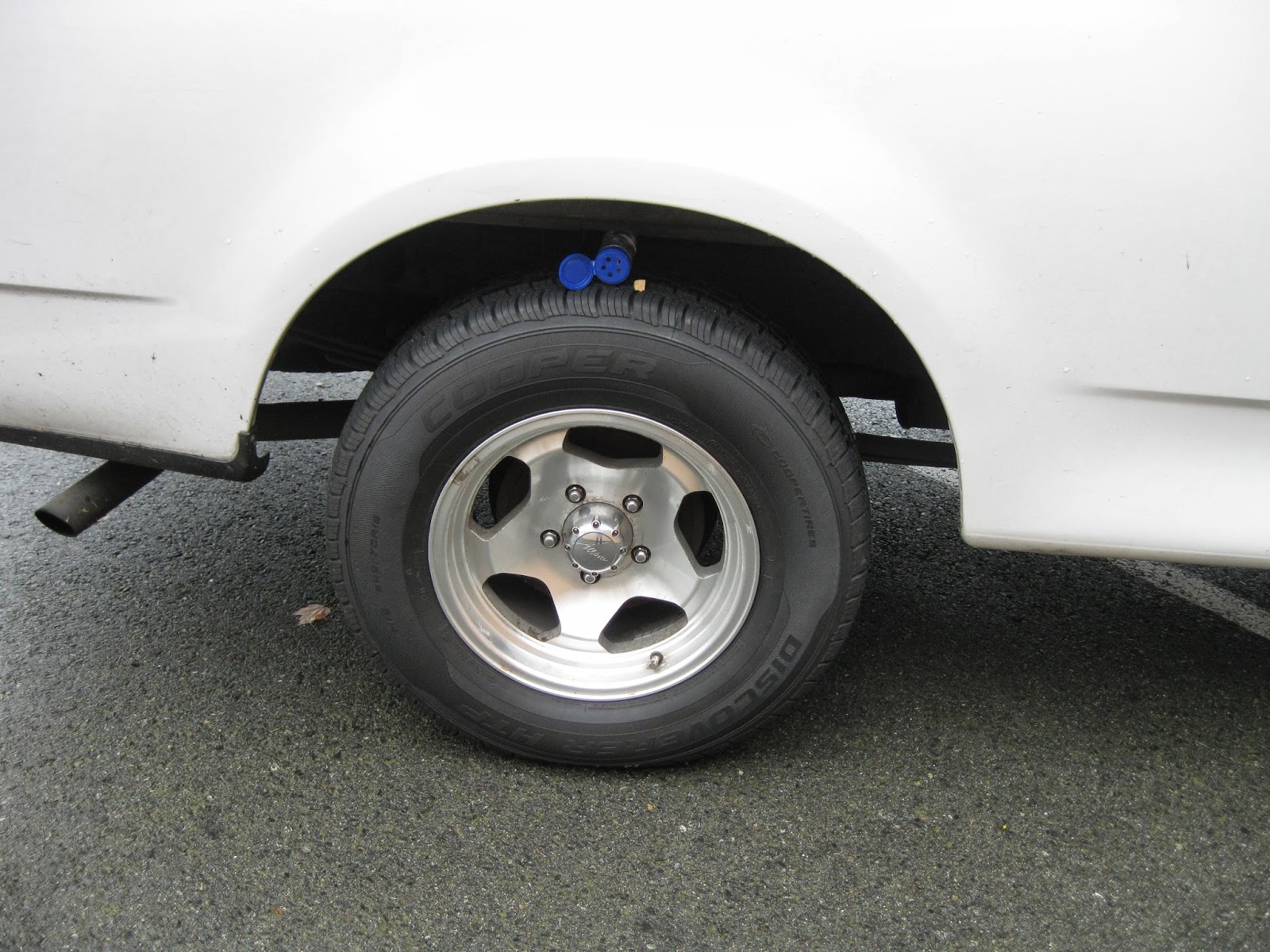
Here the odor is in a plastic container with holes in the lid and placed in the wheel well. 

  
   Here the odor is in an empty seasoning bottle.  I opened up the top and placed it on the back wheel.


   My friend, Mary, and Crosby, her English Springer Spaniel, get ready to search.

Crosby showed us how it was done first.  It was fun watching his enthusiasm!  I had to laugh when he took the clip with the odor in the plastic tube off of the side of the truck with his mouth.  What a sweet boy!  Pongo has a much gentler approach, though it makes him hard to read.  I am going to have to work on teaching him to give me a clearer "alert." 

It was wonderful watching both boys work.  It warms my heart to see how much they love it.  I am in awe of their innate talents.  Dogs are amazing.  How incredibly blessed I feel to share my life with them!

Thank you Mary and Crosby for practicing with us today!

Saturday, June 8, 2013

NACSW & The Sport of Nose Work

Pongo and I are novices in nose work.  He just finished his first class, Intro to Nose Work on Memorial Day, but we have fallen in love with it.  I have decided to train Pongo to try and pass his ORT later this year, and hopefully start earning titles in 2014.  I registered Pongo with the National Association of Canine Scent Work today.  He is an official scent work dog!


Here is what we have learned about nose work. 

A Little History   The sport of nose work is very new - less than six years old!  It began in 2009 with the very first trial in Southern California, but has grown to include sanctioned events nationwide.  The National Association of Canine Scent Work (NACSW) was founded as the organization that oversees and officiates the sport, awarding titles to dogs of all ages and breeds, including mixed breeds.  Ron Gaunt, one of the founders, is a retired police officer who worked in the K9 unit with the Inglewood Police Department.  He started NACSW along with Amy Herot and Jill-Marie O'Brien, both trainers, in order to bring nose work to everyone in the form of competitive fun.  One of the reasons I am excited about this organization and sport is that nose work has been embraced as a way to rehabilitate rescue dogs.  Amy Herot spends some of her time volunteering to improve the lives of rescue dogs.

The Sport   Dogs and their handlers can earn titles that test their ability to detect three different scents.  Levels of difficulty can include container and vehicle searches. 

NW1: The dog has to demonstrate proficiency in recognizing one target odor.

NW2: The dog has to demonstrate proficiency in two target odors.  In addition, the difficulty level is increased with larger search areas, more hidden odors, and adding environmental distractions.

NW3: The dog has to demonstrate proficiency in three target odors, and the difficulty level is significantly increased.

These are the three basic titles, and then there are also "element" and "elite" titles that can be earned.

The ORT   In order to enter trials, handler/dog teams must have passed an Odor Recognition Test (ORT) prior to being allowed to register for a trial. This ensures that the dog knows the targeted scent that will be used in competition.  In order to pass an ORT, the dog has to identify the location of the target odor, and the handler has to correctly call an ‘alert’ within a three-minute time period.

To compete in the sport of K9 Nose Work®, dogs have to transition from searching for food or toys to searching for a "target odor". Target odors for competition in NACSW K9 Nose Work events are made using 100% cotton swabs, cut in half and scented with one of the three essential oils: Birch, Anise, and Clove.

In training, target odors are introduced in a spefici order.  First, birch, then anise, and then clove.


Pongo has a private training session on Tuesday with our instructor from his Intro to Nose Work class.  We will be transitioning from searching for food and introducing him to birch!  Fun, fun, fun!


Please visit the official NACSW website for more information.