2002. Dog needs owner. Girl needs dog. An adoption from the Washington Animal Rescue League in Washington, DC is the beginning of a beautiful relationship! Follow Pongo's adventures today as he hikes, learns the new sport of nose work, and spends his days playing with the family's four cats in Western Washington. Stay tuned as his amazing life story unfolds.


Sunday, January 26, 2014

Rescued With Trust - Guest Blog by Heidi Steinbeck, CPDT-KA

A NOTE FROM EVA:  Here are some startling 2012 statistics.  According to www.statisticbrain.com, a website that publishes statistics and financials of organizations in the U.S, 5 million companion animals enter the shelter system annually.  60% of dogs and 70% of cats are euthanized.  Other sad statistics from another source include the fact that 20% of dogs relinquished to a shelter were adopted from a shelter. Reasons for return are most often due to dog behaviors that the owner doesn't like or can't deal with.  

Education about dog behavior and training is essential to change these dire statistics.  This is an issue very close to my heart.  It is essential that we stop looking at dogs as disposable. 

With this in mind, I asked Heidi Steinbeck, CPDT-KA, to share her thoughts on rescue dogs and the importance of using positive training techniques.  Heidi is the owner/trainer of Great Shakes Dog Training, educated to train dogs through Jean Donaldson’s Academy of Dog Trainers and serves the areas of Gig Harbor, Tacoma and Port Orchard.

Rescued with Trust
By Heidi Steinbeck, CPDT-KA
Training dogs cooperatively and compassionately is currently accepted as modern dog training.  It is  
backed up with a pile of well done research and successful training for all manner of dogs by those skilled in positive reinforcement.  These methods are not new but change is slow as molasses to humans because of emotion, past investment and belief systems among other reasons.  I am wanting to put that statement out in front of the rest of this blog because all dogs can and should be taught without coercion.  These humane training methods are increasingly being adopted by zoos, pet dog trainers, police, Schutzhund and hunting dog trainers and more resulting in dogs that are more emotionally stable and enjoy the learning process.

Now let us talk about rescued dogs which may include those gathered in raids from hoarders and puppy mills, strays, feral, or surrenders.  Many have had to find ways to survive in unhealthy and dangerous environments, many have never seen the light of day or the interior walls of a home.  Some have been reared like chickens in cages or lived a whole life on the end of a chain, while others had the comforts of a home they thought was their own only to be discarded and left confused in a shelter.  So many wonderful rescue organizations are working tirelessly to get these lives into the more “normal” environments of foster or forever homes to reduce the greater trauma of prison life that is riddled with stress and for many or most, resulting in death.  Many of these canine individuals have been trying to eke out a living on their own, learning that humans and new things may be dangerous to their survival.  Whatever the case may be, they come to their adoptive homes quite often with varying levels of fear, stress, PTSD, health and behavioral problems and gaps in their learning.  

 Now let’s get back to my first paragraph.  Why-oh-why would  anyone choose to interact with these fragile souls using efforts other than those which will instill trust and reduce fear?  I ask myself this question over and over again.  I can’t nail it down except to say that unlike our forced acceptance to advancements in technological science, we are resistant to adopt advancements in learning science.  There is no greater urgency for non-coercive training for any life, be it a puppy, happy adult dog or a stressed out rescue dog.


Any dog can be brought to fear through the process of abandonment, horrid life beginnings, dubious genetic offerings, maternal stress or by just plain scaring or hurting them to get the sought after behavior.  As for humans, most of us equipped with the ability for empathy, the question of why we don’t employ compassionate methods that are readily available and effective is unfathomable to me.
Our dogs are great at camouflaging true emotions.  It is not in their best interest to “show” their fear, since in the wild this would make them easy pickings for predators.  What is often seen is aggression, not the fear kindling underneath or their avoidance in an effort to disappear.  Another way to gain respite from terror is to not do the thing that causes it to happen.  In science this is called behavioral suppression and is quite effective for the dog when trying to avoid the choke, prong or shock of a collar, getting yelled at, hit or being forcibly rolled and pinned on the side.  Looking guilty has also been a great get-out-of dodge maneuver for many as it often keeps the giver of bad things from giving the bad things, even if the dog didn’t doing anything about which to feel guilty in the first place.  When re-habilitating our canine friends, previously reared coercively, it can be a task just to get them to offer a new behavior.  In their minds they weigh the odds of success and failure and frequently offer nothing as this may be the safest choice.  The behavior of an adopted dog may be suppressed for the first month or two before you start see the real personality emerge.  Sometimes what you see are just more of the behaviors that you have been inadvertently reinforcing during that period or other behaviors that could be of greater concern.  What is important is to recognize a dog that is behaviorally “in trouble” and to seek the immediate help of a trainer skilled in modifying behavior without the use of force.  An investment early on can save a life.    

We also assert, beyond any shadow of doubt, the contribution to learning suppression by way of brain chemistry.  It is not disputed by anyone who knows behavioral science and any research article known to neuro-chemistry that during chronic stress our brains prepare us for mere survival and produce a marinade that allows for fight or flight and not much else.  So let me put this in human terms.  If I walk to my car and out of the dark I am suddenly grabbed and held by sinewy heartless hands at knife point with the cold, sharp metal pressing firmly into my quickly pulsating carotid artery, I can assure you I will not be able to answer the question, what is 9x8?  My brain will be too busy preparing for survival and cannot be bothered by silly questions.  If a dog lives this way, day after day, week after week, month after month or year after wretched year must I then explain to anyone why new learning is a struggle without first addressing the underlying issue of chronic stress?  This is a repeating saga in the lives of rescued dogs as well as dogs reared with fear.  The stress is already there, we do not have to add any deposits into that stress account.  In this scenario we must make withdrawals and transfer funds, instead, into the trust account.  Then with regular deposits, the stress account becomes more depleted and the trust account begins to yield dividends in the form of a dog who isn’t waiting for the next shoe to drop, isn’t as afraid to encounter new things or people, isn’t paralyzed when trying out a new behavior and can rest in a more peaceful state.
So, just as we would be with one another, let us be with all dogs.  Let’s teach rather than force what they will benefit from learning in order for them to live with us in our human world more comfortably and cooperatively.  As we become better educated and better consumers, we will, I’m sure, drum out the old coercive methods and lobby for the safety and wellbeing of our charges.  Do it without force, without fear and without pain.
All of the photographs in this post are of dogs who were rescued by force free trainers.  The two dogs above are Lilly and Ringo.  The stories of Hazel and Bernie, written by their owners, are below.

Hazel was surrendered because her owners could not afford on-going treatment for her mange.
She caught the eye of a few volunteers who were drawn to her because of her sad disposition. Believing that she would not make it out of the shelter without foster care, a volunteer reached out to my husband and I and we went to meet her on May 9th. We brought her into foster car the following day. Hazel spent several weeks healing from her mange, secondary skin infections and an upper respiratory infection. Once she had healed, we began working on training and officially listed her for adoption.


 Hazel was adopted for one week and returned to us. At that point, we decided that she would stay with us, as we had deeply bonded with her. Since that time, Hazel has proven to us how amazing she is time and again. Reward-based training has turned this once sad, scared little girl into a superstar whose ability to learn and to make us smile never ceases to amaze us!
 

 Bernie was left in a house when people moved out, he was eight years old. His foster family told me that he had been alone for about 2 weeks. I went armed with turkey meat to pick Bernie up. Bernie


was very thin, and had flaky dry coat, he was timid, afraid of small dogs and cats, vacuums and apparently didn’t like water. He also seemed withdrawn and kind of sad.  Every time he approached me on our initial meeting he was given a nice helping of turkey. This helped him to warm up to me and he has followed me around ever since. Bernie has thrived in the 3 years he has been with us, his coat is stunning and he is always, always happy. He has learned to trust people and is now good around small dogs and even sleeps when I vacuum.

  
 Heidi Steinbeck, CPDT-KA
Owner/Trainer of Great Shakes Dog Training

Friday, January 10, 2014

Nose Work in the Cold New Year

After ringing in the new year, Pongo had a nose work practice date with doggie friends Crosby, Lincoln and Daisy.  We met at Allan Yorke Park on a cold, Sunday morning.  The temperatures were in the low 30s and the ground was crisp with frost.  We tethered the dogs while we set up hides on the children's playground.

Pongo barks, "Let's get this show on the road!"
It was decided that Pongo should go first, since he was eager to get started.  There were seven or eight hides, all birch.  We had put out a combination of low and high hides, including some in the ground.  The odors were mostly hidden in metal, magnetic tins that we were able to attach to play equipment. But we also used some small, hollow, plastic stakes which hold your scented Q-tips and can be pushed directly into the ground.  Because it was a new search site for all of our dogs, we paired each of the hides with a treat. 
Pongo and I hadn't practiced in over a week and I was concerned that he might be a little rusty.  So I was amazed as he quickly located one hide after another.  We began to speculate:  does the scent pool stronger in the cold?  The answer is yes!  Air and scent molecules become more dense in cold temperatures, pooling in a higher concentration per square inch.  Here is a wonderful article that explains the science of scent in simple terms:  http://dogcare.dailypuppy.com/dogs-smell-scents-better-cold-4799.html.  Check it out for more info!
Crosby went next.  Crosby, who is about the same age as Pongo, has recently begun to lose his hearing.  While he used to do agility, he can no longer hear verbal commands.  His owner, Mary, started him in nose work last year as it does not rely on vocal trainer directions.  Crosby enthusiastically got right to work.  He, too, had quick success.


Crosby works scent on the ground.


 Crosby follows his nose up the stairs.

It was a wonderful way to start the new year with our dogs.  Though my friends and I are still novice nose work trainers, we are learning from our dogs each time we get together to practice.  Pongo and I look forward to more nose work in 2014.  Did Pongo make any New Year's resolutions?  Of course he did!  Pongo's goal is to start competing and earning titles this year.  But he's got to train mommy some more, who is still learning to read his signals. 
,
Wishing You All The Best With Your Canine Friend In 2014,

May Your Year Be Full Of Outdoor Exploration Together!


Pongo and Eva

Tuesday, December 31, 2013

Pongo's Merry Christmas

December 16th was Pongo's last nose work class for the fall session at Paws-abilities.  When we arrived, we found a long table was set with festive boxes.  Christmas stockings hung between each one.  I was tickled pink with excitement.  Pongo may have been too, but it was hard to tell under all his black fur.  But he distinctly wagged his tail as we started our search!  We were instructed to have our dogs go down the line, detailing each stocking, then box.  But Pongo ignored the boxes on the table and seemed only interested in smelling the stockings. I had to keep circling back to try and call his attention to the boxes.  However, each dog in class did the same thing, which lessened my frustration.  It was a difficult task.  For the next search, our instructor put the boxes on the floor.  Interestingly enough, Pongo then only cared about the boxes and ignored the stockings.  Each time, we eventually found the target odor.  The last search, the instructor told us our dogs would be searching for their own Christmas stocking.  Pongo's was a red stocking with a puppy on it, filled with dog treats. 


Once the dogs had finished all of their searches, our instructor had one more for us. She hid a treat for each of the dog owners in a box.  We were instructed to sniff each one, using our noses to decide where our own food treat was hidden. I laughed.  What a farce! I have a horrible nose and I'll readily admit it.  This would be an exercise in futility, I thought.  When it was my turn, I sniffed each one, but I thought they smelled like cardboard. They seemed all the same.  I finally settled on a purple box . . . did it smell sweet?  "Alert," I said and to my utter surprise, I was right!  Inside were several big chocolate chip cookies wrapped in plastic.  How funny - I certainly didn't smell chocolate!


I think I'll leave real nose work to the dogs.  I know who got that evolutionary gift!
 Pongo and I left class feeling happy.  We were both thankful for the generosity of our instructor and now I was in the mood for Christmas!

The rest of the week was filled with lots of baking and holiday preparation. I love baking during the holidays.  I made more than 60 gingerbread cookies for my students for the last day before the break, then awoke to a snow day with school being canceled! My daughter and I made plates of Christmas cookies for the neighbors and friends.  But on Christmas Eve, I realized I had very little for Pongo's stocking. I better start baking, I thought!  I made two batches of dog biscuits.  I tried a new recipe I found on the internet that called for two jars of babyfood applesauce.  I blended a cup of oats in the food processor into a coarse flour and mixed it with whole wheat flour.  I cut out large dog bones, then after they had cooled, I wrapped them in a big fabric bow.


Next, I made his favorite peanut butter treats, turning them over half way through the baking time so they were hard and crunchy. Pongo followed me around the kitchen as soon as they came out of the oven.  Silly Pongo, you have to wait for them to cool!


On Christmas morning, we unpacked Pongo's stocking for him.  He sat guarding his cow trachea from the cats, his homemade treats beside him on the floor. It has all been long-devoured.

It was a very merry Christmas indeed!


It's fun when mommy is off work!

Pongo urges me out the door, in search of the next scent or adventure!
Happy Holidays to All!
Wishing you happy dog days in 2014!

Wednesday, December 18, 2013

A Trip To The Farm

On December 14th, we decided to take a trip to the farm. Well, technically, it was two farms.  Saturday morning, we put Pongo in the car and drove to my cousin, Jen's house.  She and her husband, Marcus, have a small farm South of Bellingham near Lake Samish.  It's an idyllic little place that I love to visit. Pongo loves all the smells and always insists that we take a walk through the woods behind the house, which is an extremely muddy venture much of the year.


He gets impatient when I sit around the house, knitting and talking with Jen, which is what I love to do when we visit.  Pongo always reminds me that he wants to be outside exploring, by pacing and barking at me.  Finally, I indulge him. We go for a walk.  After all, that is what it's all about to him - all the wonderful smells on acres of land, a dog treasure hunt or smorgasbord.


Pongo ignores the sheep in their pen and keeps his head to the ground, nosing in the dirt and grass.


Jen and Marcus let their chickens free range in the yard.  It made me nervous the first few times we visited.  I didn't trust Pongo with them.  I was sure he might decide he wanted to chase one.  I kept him on leash when he was first exposed to loose chickens, and I never leave him unsupervised with them.  But he leaves them alone, focusing his attention on smells in the grass and the bushes.


Jen and Marcus currently have a cabin and a yurt on their property.  We visited both as we took a walk.  Here, Pongo says hello to Jen on the cabin porch.


Jen's son, Sam, stands chest to nose with their Great Pyrenees, Luther.  Luther loves to escort us through the woods, as he knows every pathway.  His job is to protect the farm animals from coyotes and other prey animals in the area.  A gentle soul, Luther will steal your heart. 

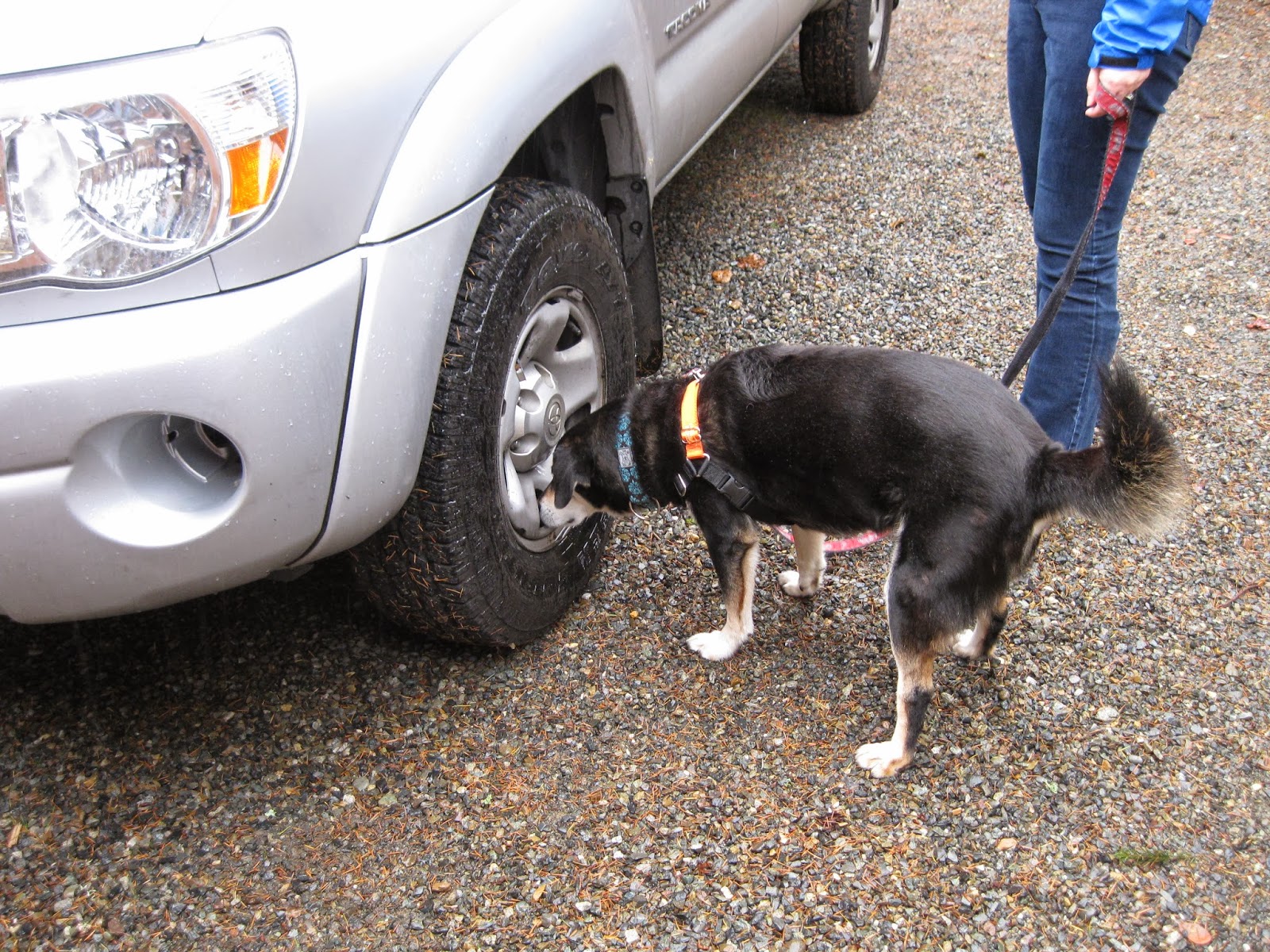
We fit in a vehicle search on Marcus' truck before we leave.  It's a great opportunity to practice nose work in a new location with lots of distractions.  At first, Pongo was more interested in smelling the surrounding terrain.  I kept him on a short leash and paired treats with the odor. 


Next, we drive North to Ferndale to visit my cousin, Aimee, Jen's older sister.  Aimee and Homero have a small working farm with several animals.  Here, the girls have just finished feeding the animals in the afternoon before it gets dark.  Ivory greets them at the gate.  Ivory is a greyhound mix who is about the same age as Pongo.  Seven years ago, she stayed with Pongo and I for several weeks when Aimee and Homero went to Mexico.  I love her dearly - it is always a joy to see her. 


The cow is the newest addition to the farm. 


Pongo meets Marley, a black lab, that Aimee's daughter, Rowan, acquired since the last time we visited.  They instantly like each other, but Marley is only a couple years old and has way more energy than Pongo does.  She wants to run and Pongo moves slowly at his own pace.


At Aimee's house, there are animals both inside and out.  They now have two ferrets, who were sleeping in their cage.  Pongo has never met ferrets.  I thought it was a good idea they stay in their cage.  Pongo once tried to eat my niece's gerbil.  He only gave it up after we pried it out of his mouth.  He definitely seems to have a strong prey drive for small rodents, which makes me continue to question his ancestral blood lines.  While hiking with Pongo and my sister's dog, Calder, last year, Pongo showed no interest when we encountered a pheasant, but Calder had to be called off the chase.  I am always fascinated how dogs have been bred for different purposes for thousands of years.  In today's society, most dogs have lost the opportunity to do the jobs they were bred for.  The result is that many dogs develop behavioral problems out of boredom, or a mismatch between the owner and dog's activity level.  Sadly, a large number of them are given up to shelters or ultimately euthanized.  In rescuing Pongo, who spent six months in a no-kill shelter in Washington, DC, my goal has been to provide him with the appropriate training and exercise to meet his individual needs.  At times, it hasn't been easy.  If you are a regular reader of my blog, you know that this is my commitment to Pongo.  When I come home tired and all I want to do is sit back and relax on the couch, I remember my commitment to Pongo, and we go out the door.


Pongo sits happily sporting his winter snowflake bandanna ($1 at Walmart)! It has been a wonderful day visiting both our two- and four-legged family in the Bellingham area.

Tuesday, November 26, 2013

Sniff & Go

What is a Sniff & Go? You're probably wondering, just as I did. I had never heard of one! It's a fun sniffing practice session held by certified nose work instructors!  Now that Pongo passed the Odor Recognition Test (ORT) in September, and we were again taking a nose work class, I began to consider entering him in his first nose work trial.  I read a wonderful guest blog where Jason Heng, a Certified Nose Work Instructor, talked about how to know when your dog is ready for a K9 nose work trial.  http://k9noseworkblog.blogspot.com/2013/11/guest-blogger-jason-heng-cnwi-answers.html  I came away from reading the article feeling that Pongo and I need more practice.  Our own instructor, Diane Porter, at Paws-abilities then told me about a Sniff & Go in Gig Harbor that was being held on November 23rd.  I filled out the entry form and mailed in my $30. 

On Saturday, after much begging, my husband agreed to go with me and take pictures and video.  The event was being held on private property in Gig Harbor. When we drove up the driveway, I suddenly felt I was in heaven.  There was an empty horse pasture, an open field and grass that sloped down the hill.  The house and barn sat on 40 acres of land, much of which was wooded.

Everyone parked in the pasture, lined up on the grass in a neat row. 


The Sniff & Go was for Level 1, 2 and 3 hides consisting of both vehicle and exterior searches.  We arrived at 10 am for Level 1.  Level 1 hides are done only with birch.


The organizers offered coffee and a warm place to rest inside the barn.  The temperature was in the 30s when we left home in the morning. I had dressed in several layers, including thermal underwear and tights as I knew we would be outside for a long time.  The warm barn was a wonderful surprise!

The instructors explained how the Sniff & Go would run and then we did a walk-through of each of the search areas, the boundaries marked by orange flags.  What I liked was that they emphasized the atmosphere was intended to be relaxed and encouraged us to ask questions if we had them.  We would be timed, but there would be no placements and we were free to go when we were finished with our searches.  We were divided into two groups so that each group could be running simultaneously.  The lower set of searches consisted of two exterior searches and one vehicle hide.  Then the higher set of searches consisted of one exterior search and one vehicle hide. 

Pongo and I were the second dog-handler team in the first group.  When it was our turn, we queued up by the orange cones to the first exterior search.  You will notice in the video below that Pongo alerts to the odor within seconds, but I don't recognize it and we continue searching.  I ask the judges a question about search boundaries, and then Pongo brings me right back to where he pointed it out before.

Pongo had found the odor so quickly that I didn't trust him. No, similar to his ORT for anise, he had to tell me twice before I believed him.  If you watch the video closely, he looks right at me the first time and even jumps toward me, as if to say, "I found it, where's my reward?"

You can reward your dog at the source with treats during a trial, but if you drop them on the ground, you contaminate the area and are given a "fault."  They have to eat the treat directly from your hand.  The time limit for this search was 2 minutes 30 seconds.  Pongo "officially" found it when I called alert at 54 seconds.  I was thrilled!  The power of his nose continually amazes me, maybe because we are new to this sport. 

The next element was a vehicle search, again with a time limit of 2 minutes and 30 seconds.  There were three vehicles parked on a slight downhill.  This time, I called a false alert when Pongo was "in odor" meaning he was near, but had not identified the source. We finished in 1 minute and 12 seconds.


The next search was held inside a fenced tennis court with a time limit of 3 minutes.  I chose to keep Pongo on leash, as I was afraid he would fixate on searching the perimeter in his excitement in being in a new place.  Pongo found the odor in 34.87 seconds.   Way to go, Pongo!!!


The judges kept track of our search data on a piece of paper.  Here I am showing my husband our results as I walk from the lower to the higher search area. 

The next exterior search was near a building and had a time limit of 2 minutes 30 seconds.  Again, Pongo found it quickly in 37.03 seconds.  I was over the moon! 

Our final search was another vehicle search. This one proved to be the most difficult for us.  With a time limit of 2 minutes 30 seconds, we finished in 1 minute 54 seconds.  However, I again gave a false alert when he was on the fringe of the odor.  It turned out that he was scenting on odor on one vehicle that was actually blowing from different vehicle behind me.  The judge noted that I was blocking the odor. 

So in our first trial situation, Pongo correctly identified 3 out of 5 hides!  The only two we failed were the vehicle searches, and we only started doing those two weeks ago!  We did better than I had anticipated, and I was beaming with pride.  My biggest fear about trials is whether or not I will be able to accurately read what Pongo is telling me. The art of nose work is in the lines of communication developed between you and your dog.  I have seen dogs that give very clear signals that they have found the odor - they stop and look at their owner, or will even sit.  I worried because Pongo didn't do any of these things - or so I thought.  Now my video tells a different story.  But when Pongo doesn't seem to give a clear signal, the judge told me to "watch his nose."  It worked!  I am learning to read Pongo's signals better.  We are communicating!

Maybe we will enter a trial in a few months, just as a practice run.  Like Jason Heng and his dog, maybe it will take us four times before we pass.  And that's ok!  We're just having fun.

Sunday, November 17, 2013

Introduction to Clove & Nose Work in the Rain

At Pongo's class last Monday, he was introduced to clove - the third and final odor in nose work.  As I have mentioned before, it is easy to introduce a new odor once your dog has learned one.  You simply pair it with the known odor.  After doing vehicle searches outside, some with birch and some with anise, the instructor had us come inside to introduce the dogs to clove.  When introducing dogs to odor, she always goes back to using boxes.  There were approximately ten or twelve boxes in a ring, and one of them had a tin with birch and a tin with clove.  Both tins were in the box.  This is called pairing. Each dog was given a chance to find multiple hides with the boxes before the end of class. Then we were each given a ziploc bag with six cut Q-tips scented with clove oil to practice at home.


I purchased two small tins with holes punched in the lid from my instructor.  The lid slides open and there is a magnet inside so you can attach it to anything metal.  These are great for vehicle hides, but also stick to the refrigerator or metal table legs, etc.  I purchased mine from Pongo's nose work instructor for convenience, but you can get them for about half the price online.  Official products can be purchased at: http://www.allgooddogs.biz/products. 

This week Pongo and I practiced with clove by pairing it with birch, each odor in a different tin, but placed together.  Instead of getting out the boxes that we practiced with while we were training for his ORT (I had broken them all down and put them away), I simply placed the two tins together in different places around the living room with a treat.  Pongo's new nose work instructor says that you should pair odor with treats about 75% of the time to keep your dog interested.  Previously, I was pairing much less than that, thinking the goal was really not to pair with food very often. 

Today, Pongo had a nose work date at noon.  We met two of my colleagues from work and their dogs for vehicles and exterior searches.  Pongo had never been to the house we met at and the driveway was gravel.  At first, he was very distracted and it took a while before he began to work.  It is always helpful to be able to have someone else watch or video you, as they may notice and be able to point out things you are not aware of.  My friend Mary noted that Pongo didn't seem to like the gravel and was walking like it hurt his feet. This made so much sense to me when I thought back to other times that we worked on gravel, but I had never really noticed. 


  Here, Pongo details the rear bumper.


Pongo sniffs the wheel well.


Pongo is rewarded at the source of odor for his find.


Lincoln, a Papillon, is an avid agility competitor who loves nose work, too.
Update: December, 2013 Lincoln earned his Masters Agility Champion (MACH) title.

To view his performance, click on the link here:


Daisy, a Chihuahua-Papillon mix and agility competitor, searches the wheel well.

It is exciting to watch dogs of all breeds enjoy and excel at nosework.  We were outside for nearly two hours this afternoon, taking turns with four different dogs - Pongo, Daisy, Lincoln and Crosby (pictured in my last blog).  The rain went from a light drizzle to a steady downpour.  Practicing in the rain, I'm told, is very important as you can't control the weather the day of a trial.  Dogs often fail at trial when it rains because they didn't train in the rain.  Well, that won't be a problem for Pongo!  Here in the Pacific Northwest we do everything in the rain.  And the rain has never fazed Pongo.  He'll stay out in the rain for hours!

I am so thankful to have a group of friends who are doing nose work with their dogs.  It is furthering my knowledge by watching them work and by having them watch me.  Thanks Mary and Ellie!

I always come home with a happy dog and that's what it's all about.


Sunday, November 10, 2013

Vehicle Search

Pongo is back in class!  We are taking a Continuing Odor class at the Paws-ablities training facility in Fife.  Our first session was last Monday, and I quickly realized the two other dogs in the class were far more advanced than Pongo is.  It made me feel guilty for not practicing much since he took his ORT (odor recognition test).  We have only practiced twice. 

Being highly goal-oriented, I am already looking ahead.  I would really like for Pongo to compete at the Nose Work 1 Level (NW1).  To earn the NW1 title, your dog has to pass indoor and exterior searches as well as a vehicle search all on the same day.  Pongo has practiced both indoor and exterior searches, but we have never done a vehicle search. 

I have a friend at school who just finished taking Intro to Odor with her dog.  Yesterday, I texted her to see if she would like to get together to practice.  We decided to do a vehicle search in the Target parking lot.  We used my husband's truck since it is actually metal (my car is fiberglass) and you can stick things to it with magnets.


 The truck parked for searching.


The odor is placed inside this rectangular metal tin with a magnet backing.  There is a treat poised on top.  We paired all of our hides today with food.


Here the odor was placed inside the plastic end tube from a poop bag roll, then put into a clip with a magnet backing. 


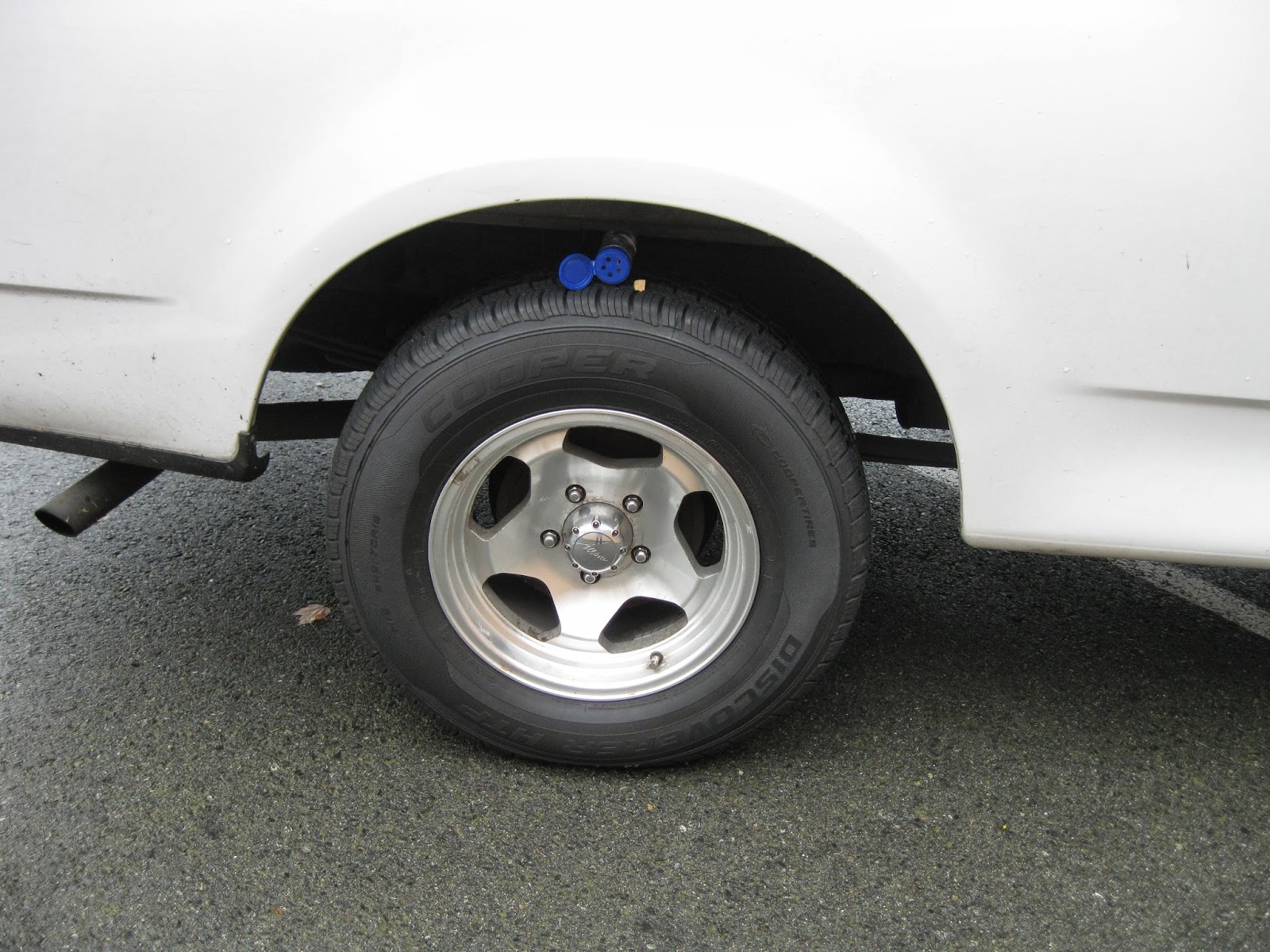
Here the odor is in a plastic container with holes in the lid and placed in the wheel well. 

  
   Here the odor is in an empty seasoning bottle.  I opened up the top and placed it on the back wheel.


   My friend, Mary, and Crosby, her English Springer Spaniel, get ready to search.

Crosby showed us how it was done first.  It was fun watching his enthusiasm!  I had to laugh when he took the clip with the odor in the plastic tube off of the side of the truck with his mouth.  What a sweet boy!  Pongo has a much gentler approach, though it makes him hard to read.  I am going to have to work on teaching him to give me a clearer "alert." 

It was wonderful watching both boys work.  It warms my heart to see how much they love it.  I am in awe of their innate talents.  Dogs are amazing.  How incredibly blessed I feel to share my life with them!

Thank you Mary and Crosby for practicing with us today!